
When Burlington homeowners ask “what are the types of AC units available?”, the honest answer is: it depends entirely on your home — its size, layout, ductwork situation, and how you use your space. Choosing the wrong AC type wastes money, strains the system, and leaves rooms uncomfortably warm even on moderate summer days. This guide breaks down every major type of air conditioner, explains what each one is best suited for, and helps you match the right system to your Burlington home before you spend a dollar.
Whether you’re replacing an aging central AC, cooling an addition without ductwork, or exploring energy-efficient options ahead of summer, you’ll find clear, practical answers here — no sales pressure, no jargon overload.
Overview: What Are the Main Types of AC Units for Burlington Homes?
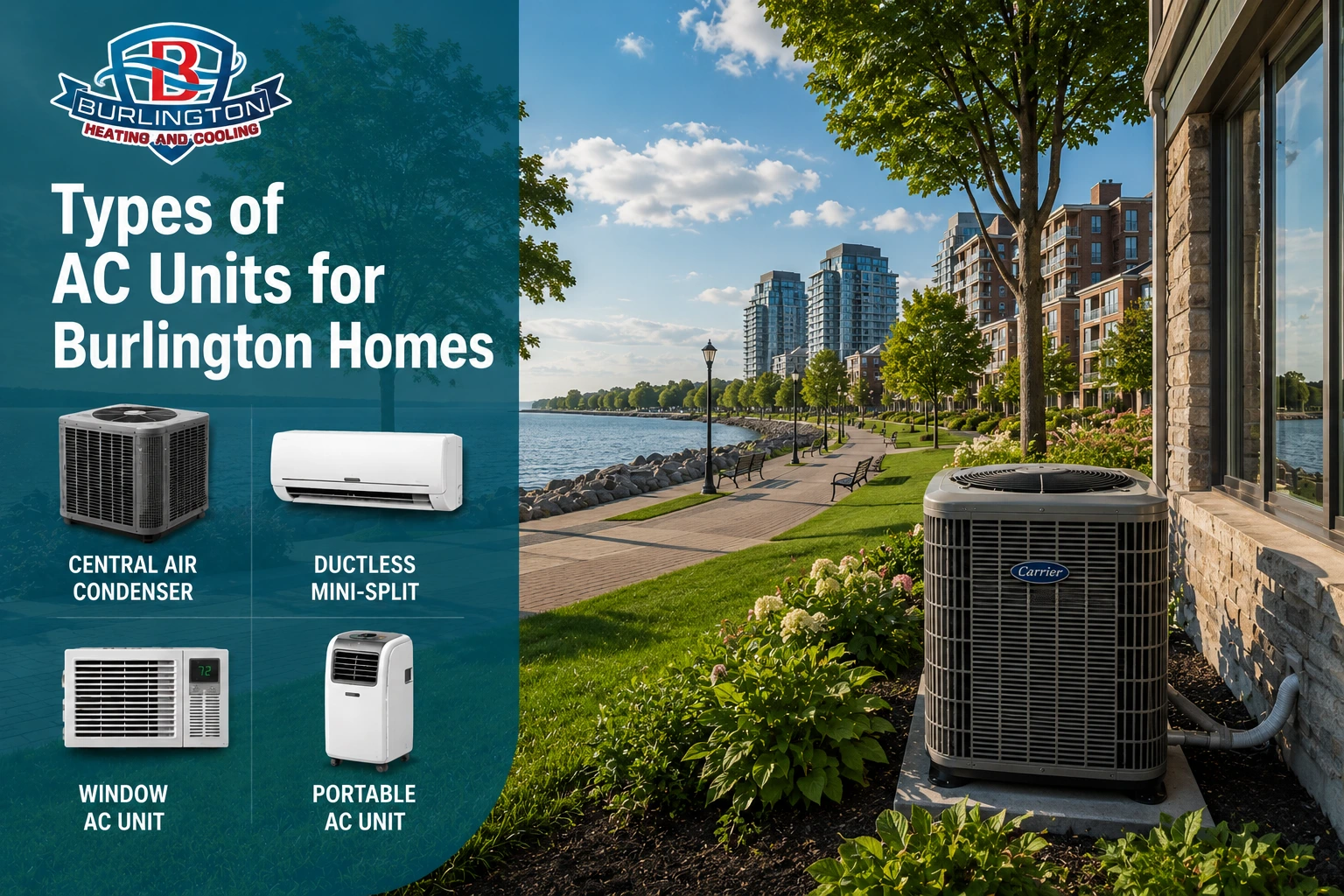
There are four primary types of AC units used in residential homes across Burlington and the broader Halton region: central air conditioning, ductless mini-split systems, window units, and portable air conditioners. Each operates on the same fundamental principle — removing heat from indoor air and transferring it outside — but they differ significantly in installation complexity, efficiency, cost, and the type of home they suit best.
Here’s a quick orientation before we go deep on each:
- Central AC — whole-home cooling via existing ductwork; highest upfront cost, lowest per-room cost
- Ductless mini-split — zone cooling without ducts; ideal for additions, older homes, or targeted comfort
- Window unit — single-room cooling; lowest upfront cost, easiest install
- Portable AC — flexible, no permanent install; least efficient option
Central Air Conditioning — Best for Whole-Home Comfort
Central air conditioning remains the most common AC type in Burlington homes built after the 1980s. A split system (the most standard configuration) consists of an outdoor condenser unit and an indoor air handler or furnace that circulates cooled air through the home’s existing duct network.
How Does Central AC Work?
The outdoor compressor pressurized refrigerant, which flows to the indoor coil. Warm air from the home passes over the cold coil, loses its heat, and is redistributed as cool air through the ducts. The extracted heat is expelled through the outdoor unit. Most modern central AC systems in Canada use R-410A or the newer R-32 refrigerants, which have lower environmental impact than older R-22 systems.
Pros and Cons for Burlington Homeowners
- ✅ Cools the entire home from a single system
- ✅ Strong dehumidification — critical for Burlington’s humid summers
- ✅ Quiet operation (most noise outside, away from living areas)
- ✅ Can be paired with existing furnace and smart thermostat
- ✅ Higher SEER-rated models significantly cut hydro bills
- ❌ Requires existing or new ductwork — expensive to add if absent
- ❌ Higher upfront installation cost ($3,500–$7,500+ depending on system and home)
- ❌ If ducts are leaky or poorly insulated, efficiency drops sharply
Best for: Burlington homes with existing ductwork, families wanting whole-home cooling, and anyone replacing an older central AC system. Learn more about our AC installation services in Burlington or explore central air conditioning options specific to Burlington homes.
(For a precise Manual J calculation, always consult a licensed HVAC tech.)
By submitting this form, you are giving your consent to receive phone calls and text messages from our contractor partners.
Get a Confirmed Size from a Pro
A certified HVAC contractor performs a Manual J load calculation for exact sizing.
Get Free QuotesDuctless Mini-Split Systems — Best for Homes Without Ductwork
Ductless mini-splits have become the fastest-growing AC category in Burlington and across Ontario — and for good reason. They deliver targeted, highly efficient cooling (and heating) without requiring any ductwork. A refrigerant line connects a compact outdoor compressor to one or more indoor wall-mounted air handlers, each controllable independently.
When Does a Mini-Split Make Sense for a Burlington Home?
- Older Burlington homes (pre-1980s) built without central duct systems
- New additions, garages, or finished basements where extending ducts is impractical
- Homes with one or two rooms that consistently run hotter than the rest
- Anyone wanting zone control — cool the bedroom at night without cooling the whole house
- Homeowners interested in a heat pump system that covers both heating and cooling
Modern inverter-driven mini-splits achieve SEER ratings of 20–30+, making them significantly more efficient than most central AC systems. If you're also considering eliminating your gas furnace, a cold-climate heat pump mini-split is worth a serious look — especially given the rebates available for Burlington homeowners.
- ✅ No ductwork required — much simpler installation in older homes
- ✅ Zone control means you only cool what you're using
- ✅ Very high efficiency (SEER 20–30)
- ✅ Quiet — indoor units run at whisper levels
- ✅ Doubles as a heat pump for year-round comfort
- ❌ Higher per-zone cost vs. extending existing central AC
- ❌ Indoor wall units are visible (aesthetic consideration)
- ❌ Multi-zone setups can get expensive for large homes
Window AC Units — Best for Single-Room Cooling on a Budget
Window units remain a practical solution for renters, condo owners, or anyone needing to cool one or two rooms without a major investment. They mount in a standard window opening, with the refrigerant coil facing inside and the condenser facing out.
For Burlington homeowners, window units work well in bedrooms, home offices, or secondary spaces — but they're a poor substitute for whole-home cooling. They cool only one room, struggle in high humidity (less effective than central systems at dehumidification), and the constant noise can disrupt sleep.
- ✅ Low upfront cost ($200–$700 depending on BTU rating)
- ✅ No professional installation required
- ✅ Good for renters or temporary cooling needs
- ❌ Cools one room only
- ❌ Noisy compared to central or mini-split systems
- ❌ Blocks natural light and window access
- ❌ Lower dehumidification compared to central AC
- ❌ Security concern — can be pushed in from outside
Portable AC Units — Most Flexible, Least Efficient
Portable air conditioners require no permanent installation — they sit on the floor, vent through a window kit, and can be moved room to room. For Burlington homeowners, they're a useful temporary solution (renting, waiting for an installation appointment, one exceptionally hot room), but they're the least efficient type of residential AC on a BTU-per-watt basis.
The core limitation is physics: single-hose portable units draw replacement air from the room they're cooling, creating negative pressure that pulls warm air in through gaps — partially undermining their own cooling effect. Dual-hose models are more efficient but still lag behind window and mini-split units.
- ✅ No installation — fully portable
- ✅ Works in apartments, condos, rental units
- ✅ Can be stored in winter
- ❌ Least efficient type (EER ratings typically 8–10 vs. 12–15 for window units)
- ❌ Noisy
- ❌ Requires window kit (small but permanent-looking)
- ❌ Needs regular water drainage (condensate)
🏠 Not Sure What You Need? Use Our AC Recommendation Wizard
Find the Right AC Type for Your Burlington Home in 2 Minutes
Answer a few quick questions about your home and our free tool will match you with the best AC type and size — no registration, no pressure.
- ✔ Central AC vs mini-split
- ✔ Sizing by square footage
- ✔ Budget range guidance
- ✔ Burlington rebate eligibility
Factors to Consider When Choosing an AC Unit for Burlington
The right AC type isn't determined by price alone — it's determined by how your home is built, how you live in it, and what Burlington's climate actually demands from a cooling system.
Does Your Home Have Existing Ductwork?
This single factor changes the economics of every other decision. If your Burlington home already has forced-air heating with ductwork in good condition, central AC is almost always the most cost-effective choice — you're leveraging existing infrastructure. If you have no ducts (common in older Burlington homes with hot-water or electric baseboard heating), the cost comparison shifts dramatically toward mini-splits.
Home Size, Layout, and Cooling Priorities
Larger homes (2,000 sq ft+) with open floor plans cool most efficiently with central AC. Homes with multiple floors, distinct living zones, or rooms that overheat (bonus rooms above garages are notorious for this) benefit from mini-split zone control. Refer to our air conditioner sizing guide for a detailed breakdown of BTU requirements by room type.
Burlington's Humidity and Its Effect on AC Performance
Burlington sits along Lake Ontario, which adds moisture to summer air. An AC system that cools well but dehumidifies poorly will leave your home feeling clammy even at 22°C. Central AC systems with properly sized coils and mini-splits with dedicated dry mode handle this best. Window and portable units dehumidify, but their capacity is limited relative to the latent heat load Burlington summers produce.
Energy Efficiency: SEER Ratings and Your Hydro Bill
The Seasonal Energy Efficiency Ratio (SEER) tells you how many BTUs of cooling you get per watt of electricity consumed. In Ontario, minimum SEER for new central AC installations is 14. High-efficiency central AC runs SEER 18–22. Mini-splits commonly achieve SEER 20–30. Over a 10-year lifespan, the difference between a SEER 14 and SEER 20 system can exceed $2,000 in hydro savings for a Burlington home. Use our AC Savings Calculator to model this for your specific usage.
By submitting this form, you are giving your consent to receive phone calls and text messages from our contractor partners.
Reduce Your Energy Costs
A properly sized, high-efficiency AC keeps operating costs low. Get free quotes from certified contractors.
Get Free QuotesExpert Recommendations for Burlington Residents: Which AC Type is Right for You?
After walking through the options, here's how Burlington HVAC professionals typically approach this recommendation in practice:
You Already Have a Forced-Air Furnace and Ductwork
→ Central AC, SEER 18 or higher. Among the most popular types of AC units in Burlington, a high-efficiency central AC system is ideal if your home already has ductwork. It provides whole-home comfort, strong dehumidification, and lower operating costs. If your ducts are older, have them inspected for leaks before installation, as leaky ducts can reduce efficiency by 20–30%.
No Ductwork — Older Burlington Home
→ Ductless mini-split system, single-zone or multi-zone. Adding ductwork to a finished home typically costs $4,000–$8,000 and involves opening walls. A multi-zone mini-split delivers equivalent or better comfort at similar or lower cost — with higher efficiency built in. If you heat with gas now, consider a cold-climate heat pump mini-split: it covers both cooling and heating, and you may qualify for federal and provincial rebates of $10,000 or more.
Condo, Apartment, or Rental Unit in Burlington
→ Window unit (owned) or portable AC (renting). Among the different types of AC units in Burlington, a properly sized window unit is the most practical option if your building doesn't include central cooling. For renters who can't install permanent equipment, a dual-hose portable AC offers flexibility, though with lower efficiency.
You Have One Chronically Hot Room or a New Addition
→ Single-zone mini-split. Extending central ductwork to one problem room often costs more than installing a dedicated mini-split — and the mini-split will perform better. Bonus rooms above garages, sunrooms, and finished attics are classic Burlington applications for single-zone systems. See our blog on AC repair vs. replacement if you're trying to decide whether to upgrade your whole system or address a single zone.
Quick Comparison: AC Types at a Glance
| AC Type | Best For | Typical Cost (Installed) | SEER Range | Ductwork Needed? |
|---|---|---|---|---|
| Central AC | Whole-home with existing ducts | $3,200–$6,800 | 14–22 | Yes |
| Mini-Split | No ductwork / zone cooling | $2,500–$6,000/zone | 20–30+ | No |
| Window Unit | Single room / budget cooling | $200–$700 | 10–12 | No |
| Portable AC | Renters / temporary use | $350–$800 | 8–10 | No |
Conclusion: Match the AC Type to Your Home, Not Your Budget Alone
The types of AC units available for Burlington homes each solve a different problem. Central AC delivers whole-home comfort at the lowest per-square-foot cost when ductwork already exists. Ductless mini-splits are the smart choice for homes without ducts, additions, or anyone wanting zone control with top-tier efficiency. Window units serve their purpose for single rooms and tight budgets. Portable units are a last resort — functional, but not a long-term solution.
Burlington's humid summers make choosing the right types of AC units in Burlington important. Central AC and ductless mini-splits offer the best whole-home comfort and dehumidification, while window units are best for single-room cooling.
If you're still weighing your options, the AC Recommendation Wizard can help narrow it down based on your specific home and budget. Or if you'd like a professional set of eyes on your home before you decide, request a free estimate — our Burlington technicians assess your home and give you honest, straightforward advice with no pressure to buy.
🏡 Burlington's Trusted HVAC Team
Ready to Choose the Right AC for Your Home?
Licensed Burlington HVAC technicians. Free in-home estimate. Same-week installations. We'll tell you honestly which AC type fits your home — and which ones don't.
📍 Serving Burlington, Aldershot, Waterdown, Oakville, Hamilton & surrounding areas
FAQs: Types of AC units in Burlington
A central AC system (SEER 18+) is ideal for homes with ductwork. For older homes without ducts, a ductless mini-split is usually the best option.
AC installation in Burlington typically costs $3,200–$6,800, depending on system size. A 2-ton unit costs about $3,200–$4,900, a 2.5–3 ton unit costs $3,700–$5,900, and a 4–5 ton unit costs $4,600–$6,800.
Mini-splits are more energy-efficient and work well without ductwork. Central AC is often more practical and cost-effective for homes with existing ducts.
Yes, for cooling a single room. However, central AC or mini-splits provide better whole-home comfort and humidity control.
Yes. Heat pump mini-split systems may qualify for rebates through federal and provincial programs, while standard central AC systems have fewer rebate options.
