

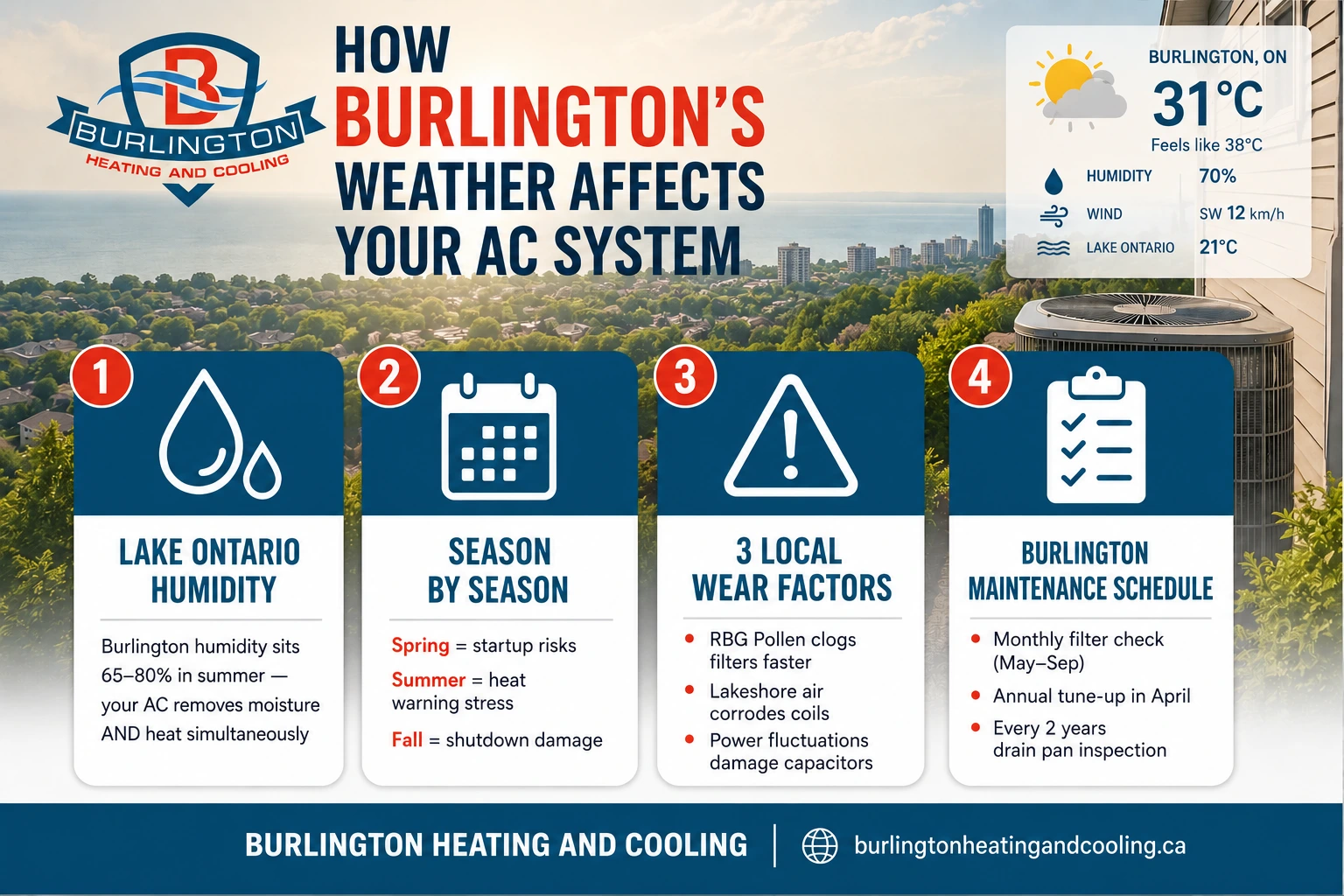
Burlington air conditioning needs are unlike those in most other Ontario cities — and if you’ve ever wondered why your AC works harder here, runs longer, or breaks down more often than your relatives’ systems in other towns, the answer is largely outside your window.
Burlington sits in one of the most climate-challenging corridors in the province, squeezed between Lake Ontario and the Niagara Escarpment, and that geography creates a unique set of demands on every cooling system in the city.
This guide is for Burlington homeowners who want to understand exactly how local weather conditions — humidity, heat warnings, seasonal swings, and lakeshore air quality — affect their AC systems year-round.
We’ll cover what to expect each season, which local factors accelerate wear, how to optimize your system for Burlington’s specific conditions, and what warning signs to watch for before they become costly failures.
🌡️ Burlington’s Trusted HVAC Experts
Is Burlington’s Climate Stressing Your AC System?
Our certified technicians understand Burlington’s unique weather challenges. Get a free estimate for maintenance, repair, or a new installation — same-day availability.
Why Does Burlington’s Location Make Air Conditioning Harder?
Most homeowners think about AC in simple terms: it’s hot outside, the unit cools the air inside. But air conditioning systems are actually doing two jobs simultaneously — removing heat and removing moisture.
This is why Burlington air conditioning needs often differ from those in other GTA cities. In Burlington, the second job is the harder one, and it runs almost continuously from late May through September.
Burlington sits on the north shore of Lake Ontario. That lake acts as a massive humidity reservoir. During warm months, moisture evaporates continuously off the lake surface and drifts inland, blanketing neighbourhoods from the waterfront up through Aldershot, Millcroft, and Tyandaga. The Niagara Escarpment to the west slows air circulation on calm days, trapping that moisture in the lower city rather than letting it disperse.
The result: Burlington’s relative humidity regularly sits between 65–80% on summer afternoons, well above the 40–50% comfort zone most AC systems are optimized for. Your unit isn’t failing when it runs constantly in July — it’s simply dealing with Burlington conditions.
Understanding these humidity challenges is essential when planning for Burlington air conditioning needs, whether you’re maintaining an existing system or considering an upgrade.
How Does Humidity Directly Affect Your AC System?
High ambient humidity forces your air conditioner’s evaporator coil to work harder to extract moisture from incoming air. This means longer run cycles, higher electricity draw, and more wear on the compressor — the most expensive component in the system. A unit that’s properly sized for a dry Ontario city like Kingston or Barrie may be genuinely undersized for Burlington summers.
Three specific problems that Lake Ontario humidity causes and why they influence Burlington air conditioning needs:
- Coil freeze-up: When the evaporator coil is working overtime to dehumidify, it can get too cold and freeze. You’ll notice ice forming on the indoor unit and a sudden loss of cooling. This is more common in Burlington than in inland Ontario cities.
- Drain line overflow: Your AC produces condensate — liquid water — as it removes humidity. In Burlington’s high-humidity summers, that’s significantly more water than in drier climates. Drain lines clog and overflow more frequently, potentially causing water damage to your home.
- Compressor overheating: Longer run times in humid conditions mean the compressor runs hotter. Systems over 8–10 years old are particularly vulnerable during Burlington heat warnings, which have become more frequent in recent years.
Environment Canada – Burlington Weather Data : Historical Climate Data Canada
How Does Burlington’s Climate Affect Your AC Through Each Season?
Burlington’s seasonal range is wider than many homeowners realize. The city sees summer humidex values above 40°C and winter wind chills below –25°C. That extreme range creates a year-round cycle of stress on HVAC equipment that affects when problems develop and when they show up.
Understanding these conditions is essential when evaluating Burlington air conditioning needs, as systems must handle both intense summer humidity and significant seasonal temperature swings throughout the year.
Spring: The Riskiest Startup Window
Burlington’s springs are unpredictable. A stretch of 22°C days in April can be followed by frost in May. Homeowners who start their AC during an early warm snap and then leave it dormant for another two cold weeks create ideal conditions for condensate buildup, mold growth in the drain pan, and rodent intrusion into outdoor units that sat idle all winter.
The safest practice: have your AC inspected and tuned up before you run it for the first time — ideally in late April. Burlington’s first significant heat warnings typically arrive in late May or early June. By then, HVAC technicians are fully booked. Booking in April puts you ahead of the rush.
Summer: Peak Demand and Heat Warning Stress
Burlington summers have become measurably hotter over the past two decades. Environment Canada data shows the city now averages 15–20 days per year with humidex values exceeding 40°C, up from approximately 8–10 days in the 1990s. That increase directly corresponds to more system failures, more emergency service calls, and more compressor replacements.
The highest-risk period for AC failure in Burlington is the 48–72 hours following the season’s first major heat event — usually in the second or third week of June. Systems that haven’t been serviced since the previous year are far more likely to fail during this window. The compressor, starved of proper refrigerant levels and running on dirty coils, simply can’t handle the sudden demand.
Fall: Proper Shutdown Prevents Winter Damage
Burlington’s fall is deceptive. Warm stretches in September and October tempt homeowners to keep running their AC well past when it’s efficient to do so. Running an AC when outdoor temperatures drop below 15°C can damage the compressor — most residential systems aren’t designed to operate efficiently in cool weather.
Before winterizing, clear all debris from the outdoor condenser (Burlington’s fall leaf volume is significant — the Royal Botanical Gardens’ surroundings generate substantial seasonal debris), cover the top of the unit loosely to prevent leaf accumulation, and have the refrigerant level checked if you noticed any performance issues during summer.
By submitting this form, you are giving your consent to receive phone calls and text messages from our contractor partners.
Get Accurate Quotes from Local Pros
These are estimates. Get precise quotes from certified HVAC contractors in your area — for free.
Get Free QuotesWhat Local Burlington Factors Speed Up AC Wear and Breakdowns?
Beyond humidity and heat, three Burlington-specific environmental factors accelerate AC wear in ways most homeowners never think about — until they’re facing a repair bill.
These local conditions play a major role in Burlington air conditioning needs, increasing system strain and making preventive maintenance more important for long-term performance and reliability.
1. Royal Botanical Gardens Pollen and Burlington’s Air Quality
Burlington borders one of the largest botanical gardens in Canada. The Royal Botanical Gardens and the surrounding green belt release significant pollen loads in spring and early summer. That pollen — along with cottonwood seeds in June and ragweed spores in August — clogs AC air filters faster in Burlington than in comparable urban environments with less green space.
A standard recommendation is to change AC filters every 90 days. In Burlington, homeowners near the RBG or in heavily treed neighbourhoods like Roseland, Shoreacres, or LaSalle Park should check filters monthly during pollen season. A severely clogged filter is one of the leading causes of coil freeze-up and compressor strain — both preventable with a $15 filter change.
2. Lakeshore Air and Condenser Corrosion
Homes within 2–3 kilometres of the Lake Ontario shoreline — covering much of downtown Burlington, Aldershot waterfront, and Lakeshore Road neighbourhoods — experience mildly elevated salt-content air. Over years, this accelerates corrosion on outdoor condenser coils and cabinet components. Systems in these neighbourhoods typically need coil cleaning more frequently (annually rather than every 2 years) and may show cabinet rust earlier than inland units of the same age.
If your outdoor unit is more than 7 years old and you live near the lake, have a technician inspect the coil fins for corrosion during your next tune-up. Early-stage corrosion is manageable; advanced corrosion on the coil often means replacement.
3. Power Grid Fluctuations During Heat Events
Burlington’s power grid, like much of southern Ontario, experiences voltage fluctuations during peak summer demand — particularly during heat warnings when the entire region is running cooling simultaneously. These fluctuations stress AC compressors and capacitors, which are sensitive to power quality. A hard start on an already-hot compressor after a brownout is one of the most common causes of capacitor failure.
A hard-start kit — a relatively inexpensive add-on installed by your HVAC technician — reduces the startup current surge and extends compressor life, particularly useful in Burlington’s grid-stressed summer environment. Ask about it during your next tune-up.
🛡️ Protect Your System from Burlington’s Climate
Burlington AC Maintenance — Designed for Local Conditions
Our technicians tune up your system with Burlington’s humidity, pollen, and heat events specifically in mind. Coil cleaning, drain line flush, refrigerant check, and more.
- ✔ Evaporator & condenser coil clean
- ✔ Drain line flush & test
- ✔ Refrigerant level check
- ✔ Capacitor & electrical inspection
- ✔ Filter replacement
- ✔ Full system performance report
Licensed & insured · Upfront pricing · Burlington’s local HVAC team
Seasonal AC Adjustments Burlington Homeowners Should Make
Generic AC advice doesn’t account for Burlington’s specific conditions. That’s why understanding Burlington air conditioning needs is so important.
Factors like Lake Ontario humidity, seasonal temperature extremes, and local environmental conditions require a more tailored approach to maintenance and system care. Here’s what actually makes a difference for homes in this city.
Before Summer: The Burlington Pre-Season Checklist
- Book your tune-up in April — before heat warnings hit and technicians are fully booked. Burlington’s HVAC providers are at capacity by late May.
- Clear the condenser area — trim any vegetation that grew back over winter. Shrubs and fences within 2 feet of the unit restrict airflow significantly.
- Check your thermostat calibration — thermostats in Burlington homes near the lake can read 1–2°C cooler than actual room temperature due to humidity effects on sensors. If your system runs constantly without reaching the set temperature, a miscalibrated thermostat may be contributing.
- Inspect and clean or replace the air filter — after a Burlington winter, filters often carry dust, mold spores, and pet dander. Start the cooling season with a fresh filter.
- Test the system on a mild day — don’t wait for a 35°C humidex day to discover a problem. Run the AC for an hour on a 20°C spring day to confirm it’s working before you need it.
During Burlington Heat Warnings: How to Protect Your System
When Environment Canada issues a heat warning for Hamilton-Burlington — typically a humidex of 40°C or above for two or more consecutive days — your AC is under maximum stress. Preparing for these extreme conditions is an important part of managing Burlington air conditioning needs, as high heat and humidity can significantly increase system workload. These steps reduce failure risk:
- Pre-cool your home before the heat peaks. Run the AC to 21°C the evening before a predicted heat day. When outdoor temps climb to 35°C+, maintaining a cool home is far easier than trying to cool it from 30°C inside.
- Close blinds and curtains on south and west-facing windows during peak sun hours (1–6pm). This alone can reduce indoor temperature by 3–5°C and significantly reduces how hard your AC works.
- Don’t set your thermostat lower than 22°C during heat events. The system can’t cool your home faster by setting a lower target — it just runs longer without shutting off, overheating the compressor.
- Check the outdoor unit every day during a heat wave. Grass, leaves, and cottonwood seeds accumulate quickly. Clear any debris from around the condenser.
By submitting this form, you are giving your consent to receive phone calls and text messages from our contractor partners.
Get a Confirmed Size from a Pro
A certified HVAC contractor performs a Manual J load calculation for exact sizing.
Get Free QuotesWhat Warning Signs Tell Burlington Homeowners Their AC Needs Service?
Burlington's climate creates specific failure patterns. These are the warning signs that are most common in this area — and what each one typically means:
- AC runs continuously but home feels humid and sticky — This is Burlington's most common complaint in summer. It usually indicates an undersized system, a refrigerant shortage, or dirty evaporator coils that can no longer absorb humidity efficiently. Left alone, this leads to coil freeze-up and eventual compressor failure.
- Water pooling near the indoor unit — High Burlington humidity means your AC produces more condensate than most systems are designed to handle. Overflow usually means a clogged drain line — a 20-minute fix for a technician that, if ignored, causes water damage to ceilings and walls.
- AC starts fine but stops cooling after an hour — Classic freeze-up pattern, very common in Burlington. The coil freezes over, air can't pass through, and cooling stops. System thaws overnight and the cycle repeats. Causes: low refrigerant, dirty coil, or restricted airflow from a clogged filter.
- Unusual noises during or after a heat wave — Grinding or screeching sounds from the outdoor unit during or immediately after a heat event often indicate capacitor strain or bearing wear — components that work hardest during Burlington's extended high-humidity, high-temperature periods.
- Higher hydro bills without obvious cause — If your electricity bill jumped 20–30% between comparable summer months, your AC is likely running less efficiently. Dirty coils, low refrigerant, and an ageing compressor all reduce efficiency and drive up operating costs.
If you're seeing any of these signs, use our AC Troubleshooting Wizard to narrow down the issue before calling for service — it can help you describe the problem more accurately and may save diagnostic time.
For a complete breakdown of when to repair versus replace, see our guide: AC Repair vs. Replacement for Burlington Homeowners.
How Can Burlington Homeowners Optimize AC Efficiency for Local Conditions?
Efficiency optimization in Burlington isn't just about choosing a high-SEER unit. It's about configuring and maintaining your system to handle what Burlington's climate actually throws at it.
Choosing the Right System for Burlington's Climate
If you're replacing an existing system or installing a new one, Burlington's conditions favour two-stage or variable-speed compressor systems over single-stage units. A single-stage AC runs at 100% capacity or off — in Burlington's sustained humidity, it often can't dehumidify effectively because it cools the air quickly and shuts off before removing enough moisture. A two-stage or variable-speed system runs longer at lower capacity, removing far more moisture for the same energy input.
For homes near the lakeshore or in older Burlington neighbourhoods with high ceiling heights and poor insulation, consider whether a heat pump might be a better long-term investment. Evaluating alternative systems is an important part of addressing Burlington air conditioning needs, especially in properties that face higher cooling and dehumidification demands.
Heat pumps handle humidity better than traditional central AC in many conditions and qualify for significant government rebates. See our comparison: Central Air vs. Heat Pump for Burlington Homes.
The Burlington-Specific Maintenance Schedule
Standard maintenance advice needs adjusting for Burlington conditions. Here's a realistic schedule for this climate:
- Monthly (May–September): Check and change air filter if needed. In Burlington's pollen season, monthly is not excessive — it's appropriate.
- Annually (April): Professional tune-up including coil cleaning, drain line flush, refrigerant level check, electrical inspection, and condenser cleaning. This single service prevents the majority of mid-summer failures.
- Every 2 years: Drain pan inspection for mold and algae. Burlington's high condensate volumes make drain pans a consistent mold risk. A technician can treat the pan with algaecide tablets to prevent buildup.
- Every 3–5 years (lakeshore homes): Coil fin inspection for corrosion. Homes within 2km of Lake Ontario should add this to their maintenance cycle.
For a full guide to service intervals specific to Burlington, visit our AC Maintenance in Burlington page.
ENERGY STAR Canada – Heating & Cooling Tips : ENERGY STAR Canada HVAC Resources
Burlington's Climate Demands a Burlington-Ready AC Strategy
Burlington air conditioning needs aren't complicated — but they are specific. The combination of Lake Ontario humidity, increasing heat warning frequency, Royal Botanical Gardens pollen loads, and lakeshore air quality creates a set of conditions that generic HVAC advice simply doesn't address adequately.
The homeowners who avoid mid-summer breakdowns are the ones who tune up in April, change filters monthly during pollen season, don't push their systems below 22°C during heat events, and act on early warning signs before they become failures. None of this is complicated — but it does need to be calibrated to Burlington's reality, not generic Ontario averages.
If you're unsure whether your current system is properly sized and maintained for Burlington's conditions, a free estimate consultation is the right starting point. Our technicians work exclusively in Burlington and surrounding communities — we know what your system is dealing with every summer.
📋 Free Estimate · No Obligation
Ready to Optimize Your AC for Burlington's Climate?
Whether you need a seasonal tune-up, a repair quote, or advice on a new system that handles Burlington humidity properly — our local team is ready. Free estimates, transparent pricing, no surprises.
- ✔ Burlington-based technicians
- ✔ Licensed & insured
- ✔ Upfront written quotes
- ✔ 24/7 emergency service
Serving Burlington · Aldershot · Waterdown · Oakville · Hamilton · Ancaster
FAQs: Burlington Air Conditioning Needs
Burlington's higher humidity means your AC removes both heat and moisture, so longer run times are normal. If your home still feels humid, have the refrigerant and coils inspected.
Check it monthly during spring and summer. In many Burlington homes, especially near heavily treed areas, filters may need replacement every 4–6 weeks.
Not always. Check your thermostat, filter, and outdoor unit first. If the problem continues, a refrigerant issue or compressor problem may require professional service.
Yes. Variable-speed heat pumps are excellent at controlling humidity and can be a cost-effective option when combined with available rebates.
April is ideal. You'll avoid the summer rush, get faster service, and ensure your system is ready before peak cooling season begins.
