
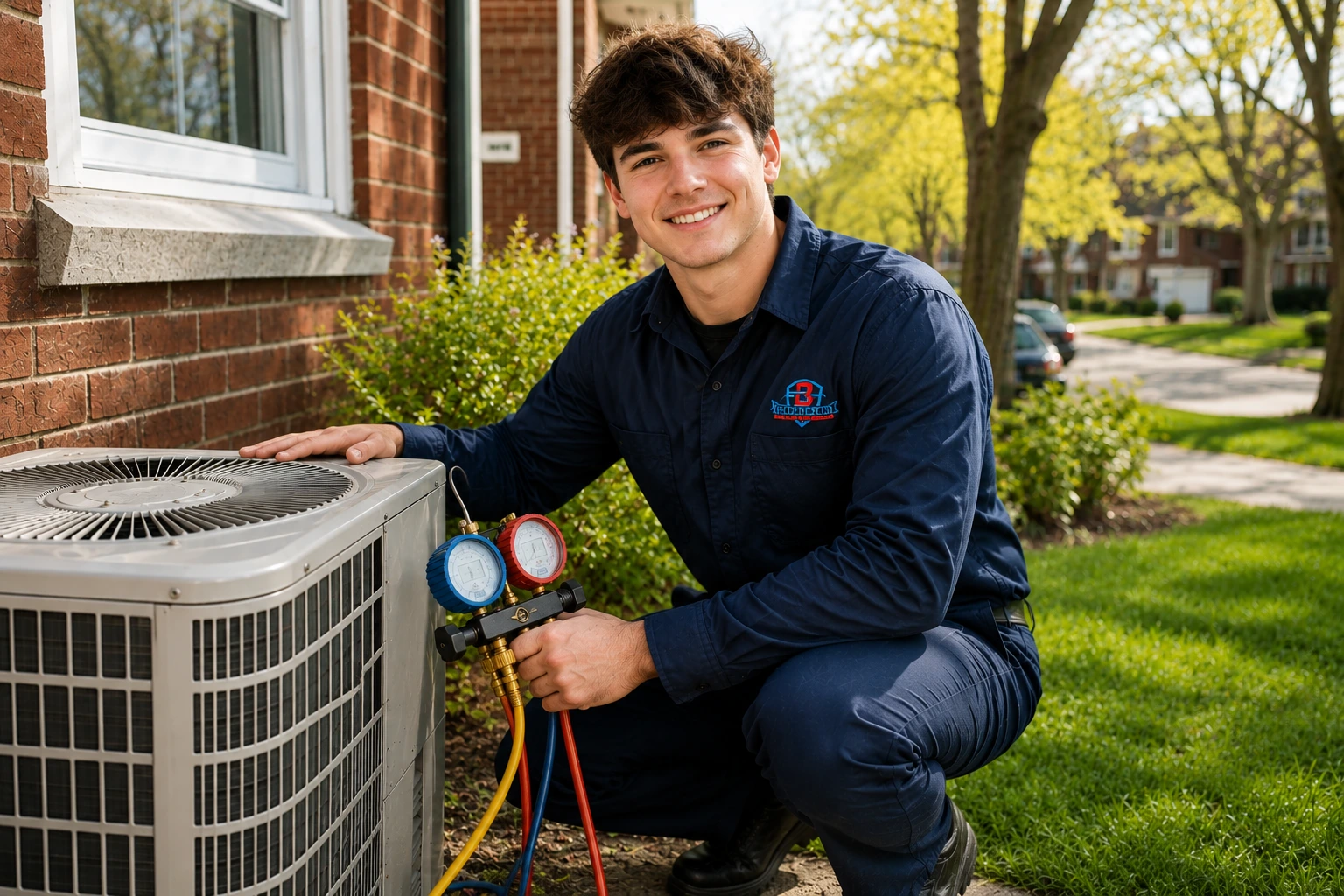
AC maintenance in Burlington should happen once a year — every spring, before the first heat wave hits. That one annual visit keeps your cooling system running at peak efficiency, catches small problems before they turn expensive, and adds years to the life of your equipment.
Burlington homeowners who skip annual service are not saving money. They are borrowing against a larger bill later. This guide covers everything — how often, what is included, what it costs, what you can handle yourself, and what to watch for between visits.
Why Timing Matters in Burlington
Most HVAC manufacturers recommend annual air conditioner service, and Burlington’s climate makes that easy to follow. Spring is the right time — specifically April or May, before the cooling season begins.
Burlington summers run hot and humid from late June through September. That is three to four months of near-continuous operation for your cooling system. A system with a low refrigerant charge, dirty coil, or failing capacitor going into that stretch will let you know about it on a 32-degree day when every HVAC technician in Halton Region is already booked.
Booking your AC tune-up in spring means your system gets a clean bill of health before the demand hits. Parts are available, technicians have scheduling flexibility, and any issues get resolved before they become emergencies.
If you missed spring, do not skip the visit entirely. A summer or early fall tune-up is still worthwhile. A system that has run hard all season often benefits from a post-summer check to catch wear that accumulated over the months.
Book your spring AC tune-up in Burlington →
What a Professional AC Tune-Up in Burlington Actually Covers
A thorough air conditioner service from a qualified Burlington HVAC technician covers a significant amount of ground. Here is a full breakdown of what should be included — and why each step matters.
Coil Cleaning — The Step with the Biggest Impact on Your Hydro Bill
Your air conditioner has two sets of coils: the evaporator coil inside your air handler and the condenser coil in the outdoor unit. Both collect dust, dirt, and pollen over time, and both lose efficiency when they do.
A dirty evaporator coil struggles to absorb heat from your indoor air. A dirty condenser coil struggles to release that heat outside. The result is a system that runs longer cycles, consumes more electricity, and still falls short on the hottest days.
Coil cleaning — done properly with the right cleaning agents — can meaningfully reduce your cooling costs and restore the system’s ability to keep up. It is one of the most impactful steps in any annual AC maintenance visit.
Refrigerant Level Check and Leak Detection
Refrigerant is the fluid that makes cooling possible. When levels drop — whether from a slow leak or a loose fitting — your system loses its ability to cool effectively.
The decline is gradual. You notice over weeks that the house takes longer to cool, or that it never quite hits the temperature on the thermostat. By the time most homeowners call for service, the system has often been undercharged for an entire season.
Your technician checks refrigerant levels and inspects lines and fittings for leaks. If levels are low, they top up the charge and address the source. In Canada, only licensed technicians are permitted to handle refrigerants — this is not a DIY task.
Electrical Components and Safety Testing
Electrical failures are one of the leading causes of mid-summer breakdowns. Capacitors — the components that start and run your compressor and fan motors — degrade over time and can fail suddenly without warning.
Your technician tests all electrical connections, checks capacitors for proper operation, inspects the contactor for wear, and confirms the system draws correct amperage under load.
Catching a failing capacitor in May costs about $80. Discovering it failed in July can mean a multi-day wait for service and potential compressor damage on top of it.
Condensate Drain Cleaning
When your air conditioner cools your home, it also removes humidity from the air. That moisture condenses on the evaporator coil, drips into a drain pan, and exits through a condensate drain line.
Over time, algae and debris clog that line. A blocked condensate drain backs up water into the pan — and if the pan overflows, you get water damage to your air handler, ceiling, or floor. Clearing the drain line is a quick step during maintenance that prevents a genuinely expensive problem.
Filter Inspection and Airflow Balancing
Your technician will check your existing filter and confirm whether it is the right type for your system. A filter that is too restrictive starves your system of airflow just as effectively as a dirty one.
They will also test airflow delivery to make sure conditioned air reaches every zone of your home. Uneven cooling — one floor always warmer, one room that never gets comfortable — often comes down to airflow issues that are straightforward to fix once identified.
Thermostat Calibration
If your thermostat reads the indoor temperature inaccurately, your air conditioner cycles at the wrong times — running longer or shorter than it should, with no obvious explanation.
Your technician verifies that the thermostat is calibrated correctly. For smart thermostat installations, they also confirm that scheduling and setpoints are configured for seasonal efficiency.
How Often Should You Service Different Types of AC Systems?
Not all cooling systems have the same maintenance requirements. Here is what you need to know by system type.
Central Air Conditioning
Standard central air — a split system with an outdoor condenser and indoor air handler connected by ductwork — should be serviced once a year. Spring is the right time. If the system is more than ten years old or has had reliability issues, add a light fall inspection before winter.
Everything you need to know about central air conditioning in Burlington →
Ductless Mini-Split Systems
Ductless mini-splits are increasingly common in Burlington homes — especially in additions, finished basements, and older homes without ductwork. These systems need annual professional service, same as central air.
They also require more frequent filter cleaning. The indoor cassette filters should be cleaned every two to four weeks during heavy use — something homeowners can do themselves. Neglecting those filters causes the indoor unit to ice over, which is one of the most common service calls we see every Burlington summer.
Heat Pumps
If your home uses a heat pump for both heating and cooling, annual service is the minimum. But a heat pump runs year-round, not just in summer — which means it works harder than a dedicated AC unit.
Many heat pump owners benefit from twice-yearly service: once in spring before cooling season and once in fall before heating season. The maintenance schedule should reflect the added workload.
Central air conditioning vs heat pump — which is right for your Burlington home? →
How Burlington’s Climate and Your Home Affect Your Maintenance Schedule
Burlington’s climate brings genuine extremes — humid, hot summers and cold winters that demand a lot from residential HVAC systems. Factors specific to your home and neighbourhood can shift how attentive you need to be between annual visits.
Homes near Bronte Creek, LaSalle Park, or other green spaces deal with more airborne pollen, cottonwood, and organic debris during spring and summer. This material collects on coil surfaces faster than in more urban areas. If your outdoor unit is near trees or garden beds, check it monthly and clear debris as needed.
Homes close to Lake Ontario experience higher ambient humidity. Your air conditioner works harder to manage both temperature and moisture simultaneously. High humidity loads can wear a system faster and make refrigerant issues more impactful. Annual service is non-negotiable here.
Older Burlington homes — particularly those built before the 1990s — often have aging ductwork, original electrical panels, and air handlers with decades of accumulated buildup. The thoroughness of your annual maintenance visit matters more in these homes than in a newer build.
Homes with pets, or where a family member has asthma or allergies, should check and replace air filters every four to six weeks during cooling season. A clogged filter pushes contaminants back into your living space — not just reduced efficiency.
Natural Resources Canada guidance on home cooling efficiency →
What Does AC Maintenance Cost in Burlington?
A standard annual AC tune-up from a reputable Burlington HVAC company typically runs between $90 and $180. Where you land depends on what is included, the age of your system, and whether any additional work is needed.
Many companies offer maintenance plans that bundle annual AC service with furnace service in the fall. These plans often bring the combined cost down to $130 to $175 for the year — less than most homeowners spend on a single emergency repair call.
An after-hours service call in July, when technicians are stretched thin, can start at $200 to $300 just for dispatch — before any parts or labour.
See what AC repairs typically cost in Burlington →
It is also worth understanding the long-term equipment math. A central air conditioning system serviced annually typically lasts 15 to 20 years. A neglected system often fails between 8 and 12 years. At $4,000 to $7,000 for a new system installation in Burlington, that difference in lifespan represents serious money.
The SEER rating of your air conditioner measures how efficiently it converts electricity into cooling. A poorly maintained system operates well below its rated SEER — meaning you are paying for efficiency you are not getting. Regular maintenance keeps the system running close to its design specifications.
Thinking about a new system? See new AC installation costs in Burlington →
DIY AC Maintenance —
What You Can and Cannot Handle Yourself
There is a meaningful amount homeowners can do to keep their cooling system healthy between professional visits.
What you can handle yourself: Replace or clean your air filter every one to three months during cooling season — every four to six weeks if you have pets or allergy sufferers in the home.
Keep the area around your outdoor condenser unit clear, with at least two feet of clearance on all sides. Gently rinse the condenser fins with a garden hose at the start of the season to remove surface dust and cottonwood.
Check that your condensate drain pan is clear and dry. Keep all supply and return vents inside your home open and unobstructed — closing vents in unused rooms does not save energy and can create pressure imbalances that stress the system.
What requires a licensed technician: Refrigerant handling of any kind is regulated in Canada and requires certification. Internal coil cleaning with chemical agents, electrical testing, capacitor replacement, contactor inspection, and condensate drain flushing all fall into professional territory. Do not attempt these.
The DIY tasks take about 20 minutes a month and genuinely extend the time between professional repairs. The professional tasks require tools, training, and certification that make delegating them a straightforward call.
How Regular AC Maintenance Protects Your Warranty
Many air conditioner manufacturers require documented annual maintenance as a condition of their warranty. If a compressor fails in year four of a ten-year warranty and you cannot show the system was properly maintained, the manufacturer may decline the claim entirely.
Keep a record of every service visit — date, technician name, company, and scope of work. A reputable Burlington HVAC company will provide a written service summary after every maintenance visit. Store those in a folder.
If you ever need to make a warranty claim, sell your home, or deal with an insurance dispute involving water damage from a condensate line failure, that documentation works in your favour.
Warning Signs Your AC Needs Service Before the Annual Visit
Annual AC maintenance in Burlington handles scheduled upkeep. But some situations need attention sooner. Call if you notice any of the following.
Your energy bills go up noticeably with no change in your usage habits. The system runs long cycles but the house never reaches the set temperature. You hear sounds that were not there before — grinding, rattling, hissing, squealing, or clicking that repeats on startup.
Ice appears on the refrigerant lines or indoor unit. Water pools around the base of your indoor air handler. Certain rooms are significantly warmer than others despite the system running. You smell something musty, burning, or chemical when the AC kicks on.
None of these resolve on their own. All of them get worse — and more expensive — the longer they run.
See the full list of AC warning signs Burlington homeowners should watch for →
AC running but still not cooling? Here is what is likely going on →
Repair or Replace?
Knowing When Maintenance Is No Longer Enough
At some point, a system that has needed repeated repairs reaches a crossover where continued patching costs more than replacing it. Knowing where that line is saves Burlington homeowners from throwing money at equipment that is on its last legs.
A useful rule of thumb: if a repair costs more than half the price of a new system and the unit is over ten years old, replacement is usually the smarter investment. A newer system with a higher SEER rating will pay back the replacement cost in energy savings faster than most people expect.
AC repair vs AC replacement in Burlington — how to decide →
How to Choose the Right HVAC Company for AC Maintenance in Burlington
Burlington has no shortage of HVAC companies, and not all of them approach maintenance the same way. A few things worth looking for before you book.
The technician should be licensed and insured in Ontario — G2 gas technician certification for gas work and refrigeration mechanic certification for refrigerant handling. Both are legally required. Ask for confirmation before booking.
A thorough maintenance visit produces a written report at the end. You should know exactly what was checked, what was found, what was done, and whether anything was flagged for follow-up. A technician who finishes in 20 minutes and leaves without explaining anything did not do a thorough job.
Look for upfront pricing with no surprises on the invoice for a standard tune-up. If additional work is needed, it should be quoted and approved before anyone proceeds. And look for local — a Burlington-based company knows the climate, the housing stock, and the specific challenges that come with homes in this area.
Frequently Asked Questions About AC Maintenance in Burlington
Once a year is right for most homes, and spring is the best time to book. Getting your cooling system serviced before Burlington’s heat season begins means any issues are caught early, parts are available, and you are not competing with emergency calls for a technician’s time.
Efficiency drops gradually without obvious symptoms until something fails. Dirty coils, low refrigerant, and worn electrical components all reduce cooling performance and increase your hydro costs. Small problems that cost $50 to fix in spring routinely become $400 repairs or full system replacements by mid-summer.
Yes, measurably. A properly maintained air conditioning system operates close to its rated SEER efficiency. Depending on the system’s condition going in, a thorough tune-up can reduce cooling costs by 10 to 20 percent over a full Burlington summer.
You can handle filter replacements, condenser unit clearing, and basic visual checks between professional visits. Everything involving refrigerant, electrical components, or internal cleaning requires a licensed HVAC technician. In Canada, handling refrigerants without certification is illegal.
April and May are ideal — technicians are available, the weather cooperates for full system testing, and any issues are resolved before the season begins. If you missed spring, a summer or early fall visit is still worthwhile.
A thorough visit from a qualified Burlington HVAC technician runs between 45 minutes and 90 minutes. If additional repairs are identified, those may require a follow-up appointment.
For many manufacturers, yes. Annual documented maintenance is a common warranty condition. Keep written records of every service visit in case you ever need to make a claim.
Age is one factor, not the only one. If the system is running well and repairs are modest, continued maintenance makes sense. If you are facing a repair that costs more than half the price of a new unit, replacement is usually the smarter long-term investment. We will walk you through the numbers honestly, no pressure.
Annual AC maintenance in Burlington is the most cost-effective investment you can make in your home comfort — one visit, once a year, before the heat arrives. Your cooling system runs better, lasts longer, and costs less to operate all season long. Do not wait until a problem announces itself on the hottest afternoon of the year. Call us today or book your tune-up online, and our Burlington team will have your air conditioner inspected, cleaned, and ready for whatever the summer brings.
